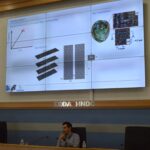
From 01 Dec till 02 Dec 25, at HNDC , a “Two-Day Workshop on Applications of Artificial Intelligence” was held in collaboration with the National Centre for Scientific Research “DEMOKRITOS” , during which the students of the 78th Educational Series had the opportunity to be informed and immerse themselves in the multitude of applications of artificial intelligence.
Lectures were given by:
- Dr. Vangelis Karkaletsis, Director and Chairman of the Board of Directors of NCSR “DEMOKRITOS” and member of the High-Level Advisory Committee on Artificial Intelligence under the Prime Minister.
- Mr. Christos Nikou, Scientific associate at NCSR “DEMOKRITOS”, as a machine learning engineer at the Institute of Informatics and Telecommunications with specialization that includes the development of machine learning algorithms for audio, video and multimodal data analysis.
- Mr. Christoforos Rekatsinas, Researcher and co-founder of the INSANE group, which researches the interaction of Artificial Intelligence and Engineering/Physical Sciences as an employee at the Institute of Informatics and Telecommunications of NCSR “DEMOKRITOS”.
- Mr. Georgios Xylouris, Researcher at the Institute of Informatics and Telecommunications of NCSR “DEMOKRITOS” on issues of management, virtualization and automation of network infrastructures .
- Mr. Alexandros Nousias, Research Associate at IIT, expert in AI Law and Ethics.
The lectures introduced students to the basic concepts of Artificial Intelligence (AI), focusing on the differences between supervised and unsupervised learning, as well as the transition from rules to data. Particular emphasis was placed on the application of machine learning techniques to the reverse engineering of advanced ballistic protection structures and materials, as well as the design of autonomous UAV and ASV platforms. The importance of fast, real-time data processing and decision support in operational environments was also highlighted.
In addition, the ethical and legal issues arising from the military use of AI were examined, with an emphasis on autonomous weapon systems (LAWS), maintaining human responsibility, and compliance with international law. Reference was made to concepts such as algorithm accountability, data bias and ethical alignment as well as to international and European regulatory initiatives, such as the EU AI Act. Finally, the importance of ethics by design and staff training for the responsible and transparent integration of AI in defense planning was underlined.